
Machine learning could help us find alien technology. Here’s how
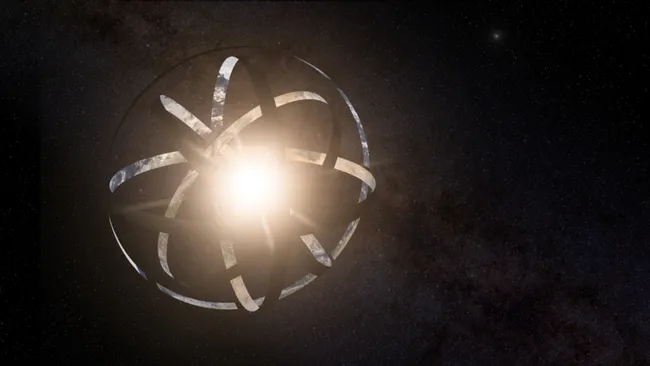
In 2015, the same year an immense observatory on Earth captured proof of the 4D fabric of spacetime, scientists began toying with a rather far-fetched idea: If intelligent aliens are out there, might they have tried making a scientific megastructure of their own? And if they did, can we find it? Actually, have we already?
In this paper, a crew of researchers presented their analysis of data gleaned from NASA’s Kepler telescope. It concerned a star that resides about 1,470 light-years from where you’re sitting named KIC 8462852, or Boyajian’s Star in a nod to the study’s lead author. According to the team’s results, Boyajian’s Star seemed to exhibit a bunch of very peculiar dips in light.
Normally, when studying a star from our vantage point in the cosmos, telescopes can naturally see dips in starlight whenever something passes between them and the star itself. Imagine you’re staring at a bright lightbulb, then someone passes in front of the lightbulb. Its emissions would appear interrupted. Usually, as you may expect, an exoplanet causes such dimming when orbiting its stellar host — but… not for Boyajian’s Star.
“It’s not a sphere,” Daniel Giles, a postdoctoral researcher at the SETI Institute said during the 243rd meeting of the American Astronomical Society in January. “It’s composed of something like a bunch of panels … it looks like what a megastructure would look like.”
Because of this, following that 2015 result, the crowd went wild. News articles, follow-up observations, opinion pieces and even just general chatter started rippling through the astronomy niche. Okay, pause. I’ll save you the trouble and let you know that the ultimate consensus was: No, these weird dips weren’t caused by a massive piece of futuristic alien technology. “It’s probably dust,” Giles said. But here’s the thing.
